
Less manual data entry
Move sales, item, customer, and payment details through a connected POS and accounting workflow.
SQL POS and SQL mPOS help retailers prepare checkout, customer data, sales records, and SQL Accounting workflows for Malaysia's LHDN e-Invoice journey.
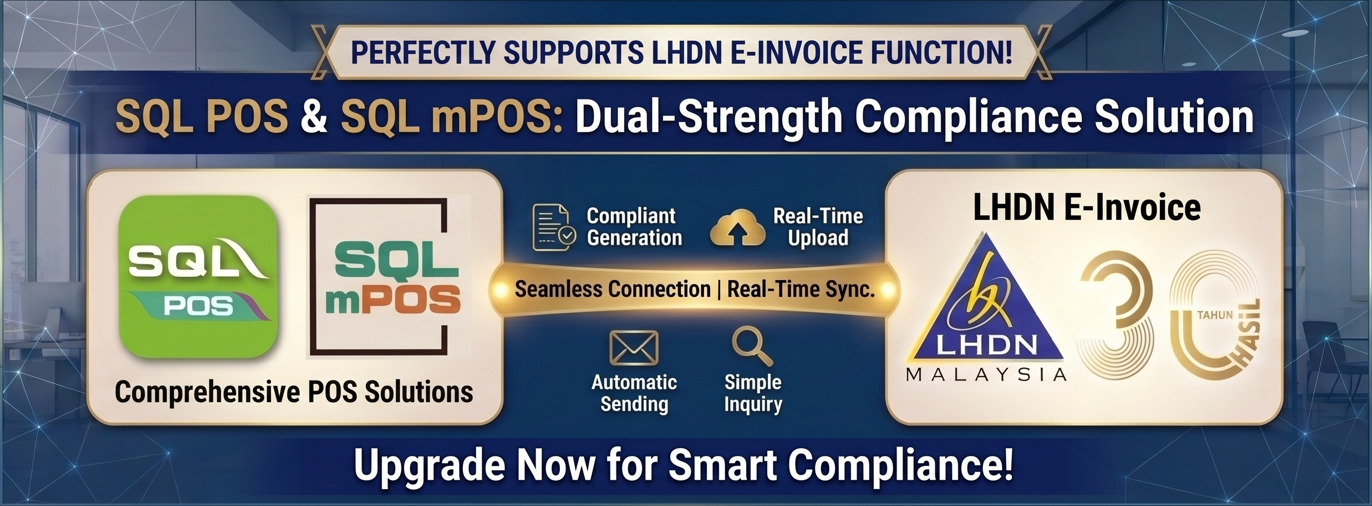
LHDN e-Invoice is implemented in phases and uses MyInvois for e-Invoice submission and validation. Businesses can use the MyInvois Portal or API, depending on transaction volume and system needs.
Phased implementation started with businesses above RM100 million turnover on 1 August 2024.
The timeline expands by turnover bands, including businesses up to RM5 million from 1 January 2026.
Businesses below RM1,000,000 annual turnover are exempted under the latest official timeline.
MyInvois API workflows include taxpayer TIN validation, document submission, cancellation, rejection, and document retrieval.
The goal is not only compliance. A good POS setup should reduce double entry, keep customer details available when needed, and connect checkout with accounting.
Move sales, item, customer, and payment details through a connected POS and accounting workflow.
Prepare buyer information at checkout when an individual e-Invoice is needed.
Keep POS sales and accounting records aligned for clearer back-office operation.
Continue counter or mobile sales during unstable network periods, then sync after recovery.
Best for fixed cashier counters, retail stores, inventory control, payment handling, reports, and SQL Accounting workflows.
SQL POSBest for mobile checkout, pop-up counters, queue-busting, multi-device operation, and flexible sales teams.
SQL mPOSRun stable counter checkout with SQL POS and extend sales mobility with SQL mPOS while keeping records connected.
Use both togetherReference points are based on LHDN/HASiL e-Invoice implementation timeline, official guidelines, and MyInvois SDK API documentation. Always confirm tax treatment with your accountant or tax advisor.
It means the POS workflow is prepared to support Malaysia LHDN e-Invoice operation, including sales data, customer details, SQL Accounting integration, and MyInvois preparation workflows.
Not always. The key is whether your POS can help capture the right sales and customer details, connect records to accounting, and support a smoother e-Invoice-ready workflow.
LHDN implements e-Invoice by turnover phases. Businesses with annual turnover below RM1,000,000 are exempted under the latest official timeline, while larger businesses should follow their phase date.
SQL POS is suitable for fixed retail counters. SQL mPOS is suitable for mobile checkout, pop-up counters, and flexible devices. Many businesses can use both together.
SQL POS and SQL mPOS support offline retail operation patterns so sales can continue and sync again when the connection recovers.
Tell us your store type, number of counters, and whether you use SQL Accounting. We can recommend a practical POS setup.